
#6 Has Your Starter Doubled? The Peak Is Exactly 1–3 Hours Away!
While analyzing how feeding ratios affect fermentation time, we uncovered a fascinating secret. By breaking down the starter's growth into just two distinct stages, predicting that elusive peak time suddenly becomes incredibly simple.

Even as we enter the early days of summer, the Toasterz team is keeping the starter experiments rolling, and we’re currently breeding an absolute S-tier starter.
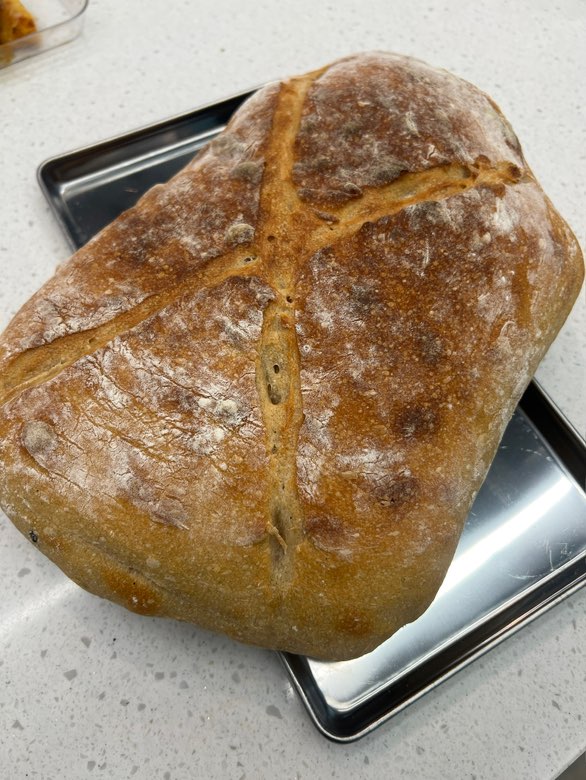
Thanks to this, we’ve been totally obsessed with sharing freshly baked sourdough slabs lately!
In our last post, we confirmed that the feeding ratio heavily impacts fermentation time.
If you spend any time in the sourdough community, this is probably something you’ve heard before.
However, when we took a closer look at the data, we realized that the impact of the ratio isn't spread evenly across the entire fermentation process.
It’s actually concentrated in one very specific window.
As it turns out, starter fermentation happens in two distinct stages.
Understanding this structure makes predicting when your starter will hit its maximum height (the peak) so much easier.
Regardless of the ratio, every fermentation session can be broken down into two main phases:
Stage 1 (Start ➡️ Doubling in Size, t100)
This spans from the exact moment fermentation begins until the starter reaches twice its initial height.
Stage 2 (Doubled Size ➡️ The Peak)
This is the window after it passes the double-height mark right up until it hits its absolute maximum height (the peak).
On the surface, these two stages might look identical, but what’s happening under the hood is completely different.
Stage 1: The Ratio Dictates Everything
The time it takes to hit that initial doubling mark (t100) varies drastically depending on your feeding ratio. Here is what our experiment data showed:
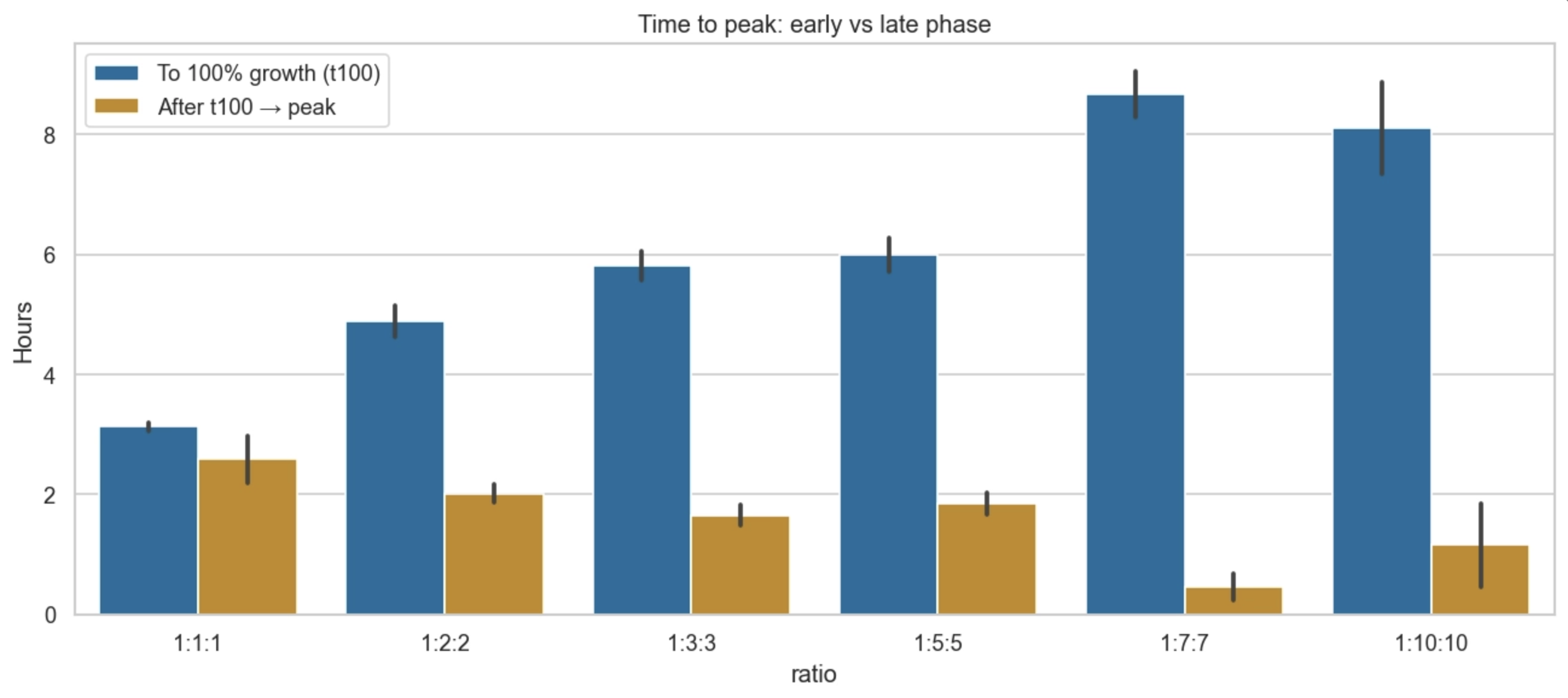
- 1:1:1 ratio: Reached t100 in about 3.1 hours
- 1:2:2 ratio: About 4.9 hours
- 1:3:3 ratio: About 5.8 hours
- 1:5:5 ratio: About 6.0 hours
- 1:7:7 ratio: About 8.7 hours
Between the lowest and highest feeding ratios, the length of this initial stage differed by nearly three times.
This is exactly how the feeding ratio pulls forward or pushes back the overall peak time.
The ratio directly dictates the speed of this first phase.
Stage 2: The Ratio’s Influence Vanishes
This is where we uncovered a mind-blowing twist.
The window from doubling to peaking stayed relatively short and consistent, completely independent of the ratio.
No matter which feeding ratio we used, it took almost everyone a mere 1 to 3 hours to hit the peak after reaching t100.
The dramatic differences we saw in Stage 1 completely vanished in Stage 2.
Even with totally different ratios, the fermentation momentum after 100% growth plays out almost identically.
What This Means for Predictions
If you can accurately predict t100 (the doubling point), you know for a fact that the peak will follow just 1 to 3 hours later—no matter what ratio you went with.
On top of that, t100 itself is highly predictable based on the initial growth rate and the feeding ratio.
Combine these two factors, and you get a remarkably accurate early forecast.
For anyone maintaining a sourdough starter, this is a massive game-changer. The moment your starter hits double its initial height, the fermentation has essentially entered the final stretch. From that point on, no matter what the ratio is, the peak will arrive within 1 to 3 hours. The ratio only determines when it hits that double-height mark.
Once you pass that doubling point, you are stepping into a much more predictable world.