
#5 Your Feeding Ratio Sets the Clock
Your feeding ratio is the single biggest lever controlling fermentation speed. Our controlled ratio experiment revealed a nearly four-hour swing in peak timing — and a clear explanation for why.

The Ultimate Lever in Sourdough Fermentation: The Hidden Power of Feeding Ratios
Here is a scenario almost every sourdough baker knows by heart.
You feed your starter on a Tuesday morning. Exactly six hours later, it hits a beautiful peak—right on schedule. Fast forward to Friday: you do the exact same thing under the exact same conditions. But this time, eight hours pass, and you’re still watching your starter crawl, scratching your head and wondering what on earth went wrong.
Same starter. Same kitchen. Same recipe—or so you thought.
The culprit? More often than not, it’s a hidden variable bakers rarely think to double-check: the feeding ratio. How much flour and water you add relative to your starter isn't just a minor recipe detail. It is the single biggest lever controlling the speed of your fermentation.
To find out exactly how much this lever matters, we ran a tightly controlled experiment. The data spoke louder and clearer than we ever expected.
What We Tested
To get pristine data, we kept every single variable consistent across our baking sessions—total weight, device settings, and ambient conditions remained perfectly identical. The only thing we changed? The ratio of starter to flour to water.
We tested six different ratio levels across multiple sessions:
- 1:1:1 – A high starter proportion with a relatively small meal of flour and water.
- 1:2:2
- 1:3:3
- 1:5:5
- 1:7:7
- 1:10:10 – A highly diluted mix, offering a massive meal relative to the starter population.
Our question was simple: Does changing this ratio actually shift the peak time, and if so, by how much?
The Result: Ratio and Peak Time Move in Perfect Harmony
The relationship was striking. The more you dilute your starter, the later its peak arrives—and this trend held up beautifully across every single ratio we tested.
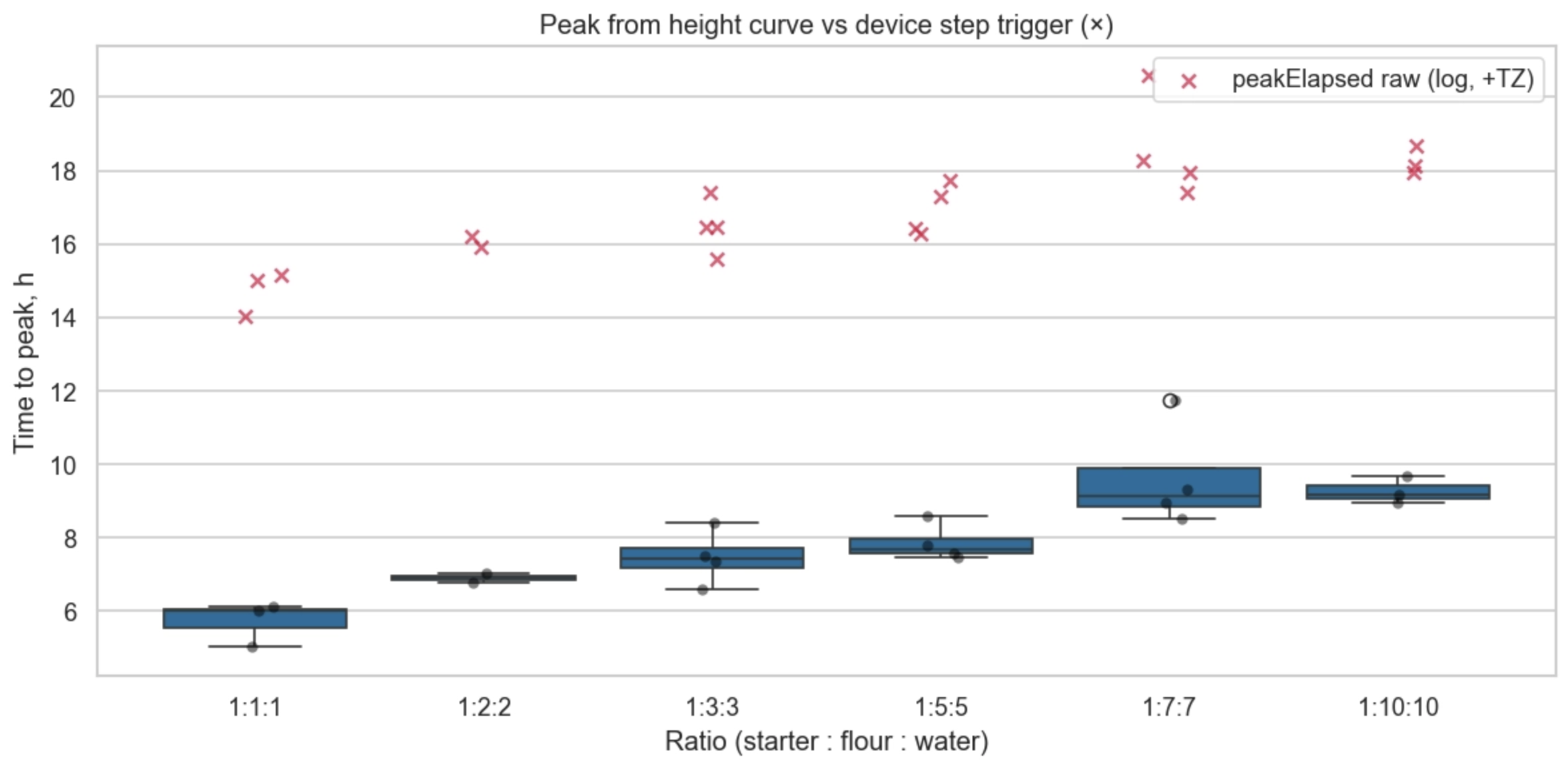
As you can see in the box plot above, the time to peak scales beautifully as the feeding ratio increases. Here is how the average peak times broke down:
- 1:1:1 (High starter concentration) → Peaks at approx. 5.7 hours
- 1:3:3 → Peaks at approx. 7.5 hours
- 1:7:7 → Peaks at approx. 9.6 hours
- 1:10:10 (Extreme dilution) → Peaks at approx. 9.3 hours
From our most concentrated ratio to our most diluted, we saw a massive spread of nearly four hours. In the real world, that is the difference between a starter that is ready to bake with at noon, and one that keeps you waiting until late afternoon.
The Science: Why Does This Happen?
The biology behind this is incredibly intuitive once you look at it from the microbes' perspective.
Think of your starter as an eager colony of wild yeast and lactic acid bacteria ready to get to work. When you feed them at a 1:1:1 ratio, you are giving that massive colony a relatively small snack. They are heavily well-staffed for the job, so they consume the food rapidly, kicking off fermentation immediately and hitting an early peak.
But when you switch to a 1:10:10 ratio, you are drastically multiplying the amount of food relative to the initial population. The colony can't just jump into full-gear fermentation right away; they have to replicate, grow, and expand into their massive new environment first. It’s not that your starter is weak—it simply has much more ground to cover before reaching peak activity.
Essentially, a higher dilution means a much longer runway before liftoff.
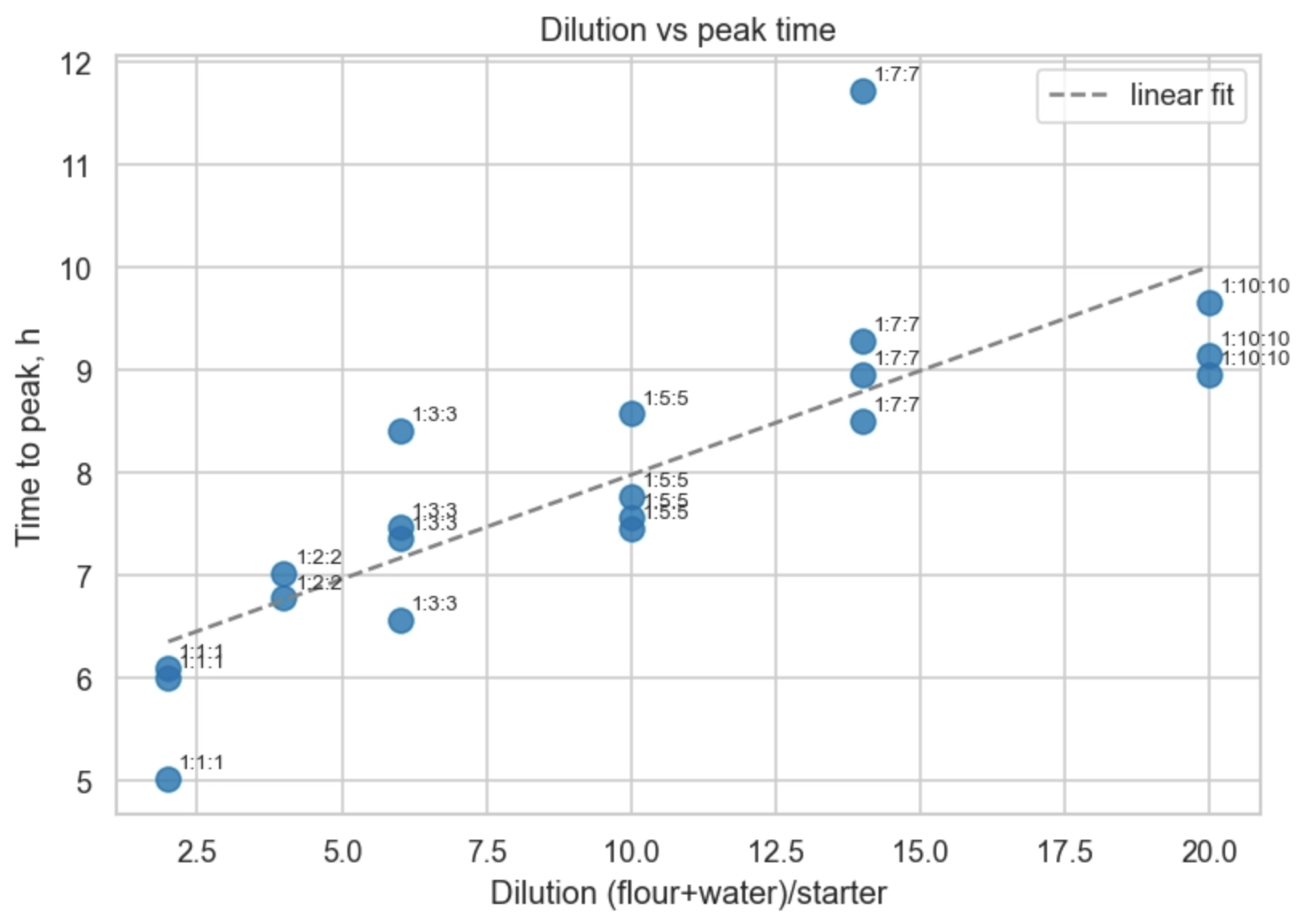
This linear fit graph perfectly illustrates the math behind the biology. As the dilution factor (the ratio of flour+water to starter) scales up, the time to peak climbs right along with it in a remarkably predictable linear fashion.
What This Actually Means for You
Your feeding ratio isn't just a personal recipe preference—it is your fermentation’s default schedule.
If you always bake using a 1:1:1 ratio, your starter is going to behave completely differently than a friend's starter fed at 1:5:5. Even if you share the exact same flour, the same kitchen temperature, and the same starter culture, the ratio alone will cause a multi-hour swing in your timing. It’s not a question of whose starter is healthier; it's just the physics of the ratio.
For the SourFriend prediction model, this means the feeding ratio is an absolute game-changer. By knowing the exact ratio you used at the start of a session, our model gets a massive head start in narrowing down exactly when your starter will hit its prime.
One More Layer to Unpack...
Knowing the overall impact of ratios on peak timing is incredibly useful. But we wanted to go even deeper: Where exactly in the fermentation timeline does the ratio exert its power?
Is the delay spread evenly across the entire session? Or is it heavily concentrated in one specific phase?
The answer completely caught us off guard—and it has massive implications for how we predict fermentation. We will break that down in our next post.
Stay tuned for Part 2!